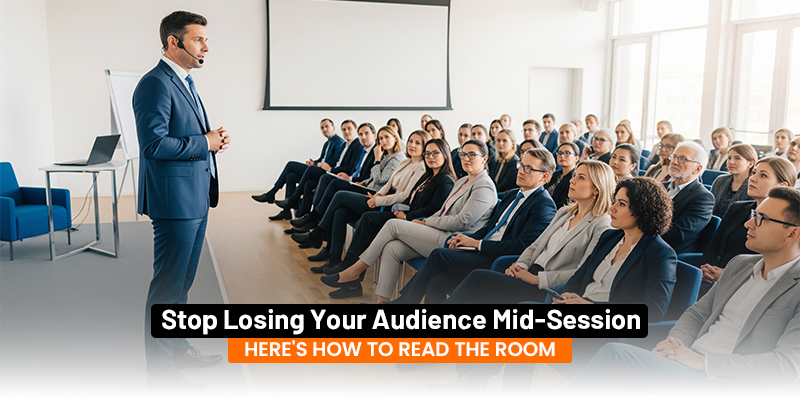
Stop Losing Your Audience Mid-Session: Here's How to Read the Room
Remember the last time you felt a training session slip away from you? Not dramatically, not all at once, but quietly. One person lost interest, then another, and before you knew it, the energy in the room had flatlined. You kept going. Something felt off, and you knew it.
That feeling is more common than most trainers admit. Luckily, it is also one of the first things addressed in a train-the-trainer course in Mumbai because holding someone's attention is a skill in itself, and most trainers are never actually taught how to do it.
Why Do Participants Lose Interest Halfway Through My Training Sessions?
Most of the time, the content is not the problem. What loses people is not seeing why any of it matters to them. If it does not connect to their work or their life, the mind just wanders off. Some other reasons this happens:
- Sitting in the same position for too long with no change in activity.
- Too much one-way talking with no room to respond or ask questions.
- Content feels theoretical with no connection to their actual work.
- The room is too cold, too warm, or just physically uncomfortable.
- No sense of what comes next or how long this segment will last.
How Can I Tell If My Audience Is Getting Bored While I'm Speaking?
The signs are usually right in front of you. The trouble is that most trainers are too focused on their own delivery to notice them. Here is what disengagement actually looks like in a room:
- Phones appeared on the table, one by one.
- Shoulders dropping, bodies slowly sinking into chairs.
- Eyes on you, but clearly thinking about something else entirely.
- Whispers starting between two people at the side.
- A quiet in the room that feels more like giving up than paying attention.
Quick Tip: Watch the feet. People can fake attention with their faces, but their feet give them away. When you check someone out, their feet usually point toward the exit before the rest of their body does.
Read Next: Is Personality Development Just About Looks or Something More?
What Are Some Simple Ways to Read the Room During a Live Session?
Reading the room comes down to three things. Are they paying attention? Are they actually interested? And how are they feeling about what is happening? A few simple ways to track all three:
- Move around the room instead of staying fixed at the front. Your position changes what you can see.
- After a big point, pause and ask a simple question. Not a test, just a moment that invites someone to respond.
- Watch for repetition. One person yawning is normal. Three people yawning in ten minutes is a signal.
- If something you said landed flat, note it and adjust. Do not barrel through.
If you feel the room drifting, say something. Not to call anyone out, but just to reset. Something casual like "I think I lost you there, let me try that again" does more than any engagement trick ever will.
Is It Possible to Adjust My Training Style on the Spot If Engagement Drops?
Yes, absolutely. In fact, this is what separates a good trainer from a great one.
A good trainer delivers their material well. A great trainer notices when the room has shifted and does something about it, even if that means skipping a slide, taking an unplanned break, or changing the activity on the spot.
Sometimes a small change is enough. Slow down. Ask a question instead of making a point. Let someone in the room explain it back to you. That alone can shift the energy in under a minute. Other times, you need to do more. A short break, two minutes to stand up and stretch, can do more for a room than pushing through ever will. The time does not go to waste. It actually helps people take in more when they sit back down.
The hardest part is letting go of your own plan. If something is not working, stop it. If a point isn't landing, try a different approach. Holding onto the agenda when the room has already left it helps no one.
Preparation Matters More Than Rescue
The best time to deal with disengagement is before it starts.
Before the session, think about who is in the room. What do they already know? What do they actually care about? The more your content speaks to them specifically, the less you will have to work to keep them.
Start with something real. A short story, a scenario from work, a question they will actually want to answer. The first two minutes tell your audience whether this is worth their attention.
Keep the conversation going throughout. Not forced activities, just genuine moments where people get to respond, react, or connect what they are hearing to their own experience.
Will Joining a Train the Trainer Course in Mumbai Help Me Keep My Audience Engaged?
Yes, especially if you have ever stood in front of a room and felt like you were talking but no one was listening.
Persona's train-the-trainer course in Mumbai starts from a simple truth. Most sessions fail not because the content is weak, but because the trainer narrates rather than connects. The course teaches you to stop being a narrator and start being someone the room actually responds to. Here is what you will actually work on:
- How to design a session that flows like a story rather than a checklist.
- Using your voice, pace, and silence to control the energy in the room.
- Reading the room and sensing when attention is dropping before you lose people completely.
- Giving and receiving feedback without ego getting in the way.
It is not just for professional trainers. It is for team leads, managers, and anyone responsible for helping others grow and perform better. Persona prepares you for that reality, not a comfortable classroom version of it.
Wrapping Up
Reading the room is not something you either have or don't. It is a skill, and like any skill, it gets better with practice and the right guidance. At Persona, that is exactly what you get. Not theory, but real practice in a real room with feedback that actually helps you grow. If you are ready to become the kind of trainer people remember, reach out to us today.
Frequently Asked Questions
- Do I need years of experience before taking the train-the-trainer course at Persona?
- Is this course only for people who train professionally?
- Will I get to practise during the course, or is it mostly theory?
Not at all. The course builds the skill from where you currently are.
No, it is for anyone who needs people to listen, whether that is a manager, a team lead, or a facilitator.
It is mostly practice. You will be on your feet, delivering sessions and getting real feedback throughout.